
By CRIC INFO 365 Staff | September 19, 2026
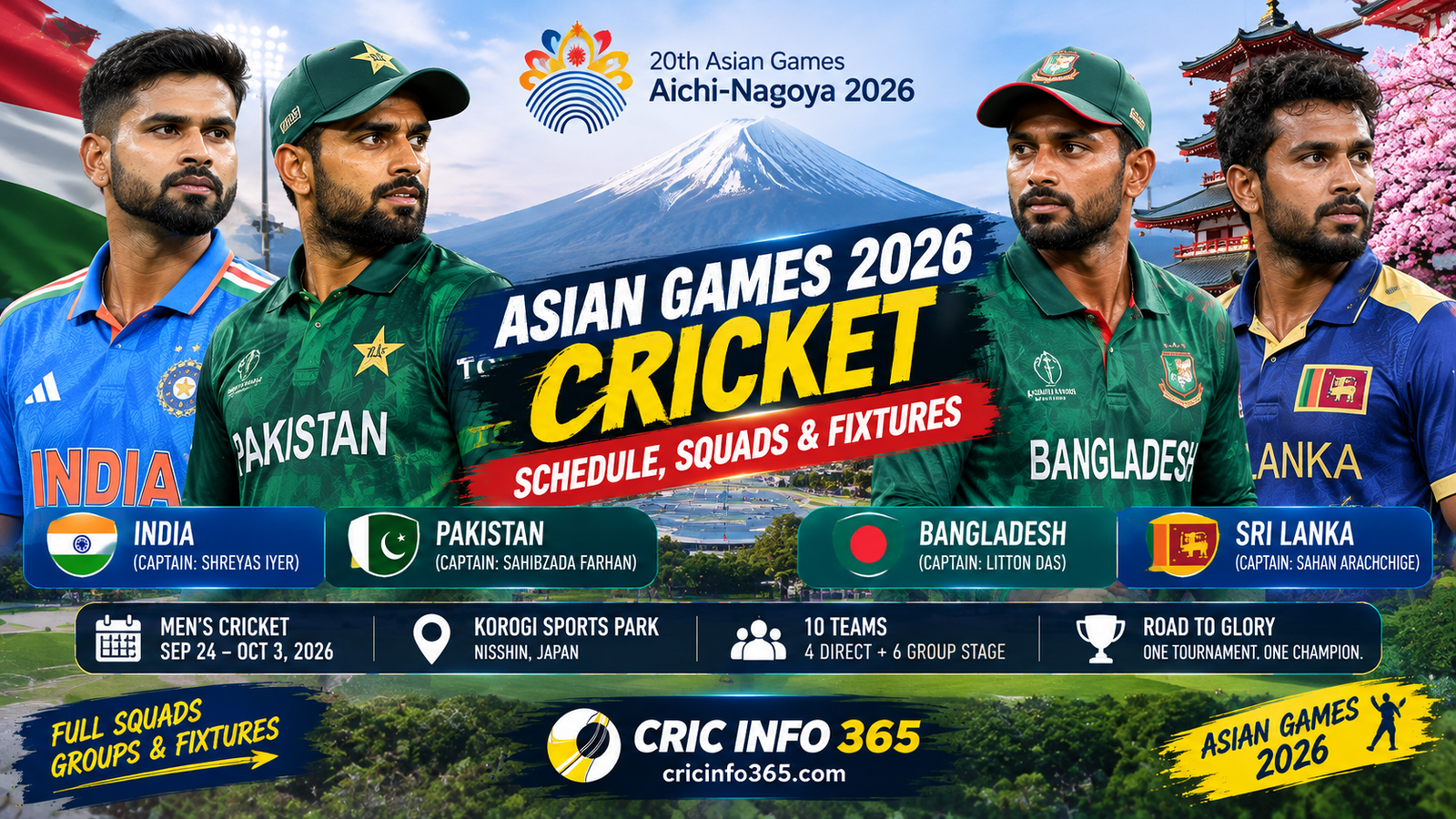
Men’s cricket at the Asian Games 2026 runs from September 24 to October 3 at Korogi Sports Park in Nisshin, Japan, as part of the wider Aichi Nagoya Games. Ten teams are involved. India, Pakistan, Bangladesh and Sri Lanka go straight into the quarterfinals, while Afghanistan, Japan, Nepal, Hong Kong China, Malaysia and Oman fight through a preliminary group stage first. Every major cricketing nation has sent a full strength squad this time, which is not something you could say about the last edition.
Here is the complete breakdown of dates, groups, fixtures and squads, plus a look at why the seeding worked out the way it did.
When and Where Is the Cricket Tournament Being Played?
The 20th Asian Games takes place in Aichi Prefecture, Japan, from September 19 to October 4, 2026, and cricket is one of 41 sports on the program. The men’s cricket event specifically runs September 24 to October 3, played at Korogi Sports Park in Nisshin, a city just outside Nagoya. The organizers keep the official, continuously updated schedule on the Olympics.com Asian Games site, which is worth bookmarking alongside this page.
This is only the fourth time cricket has featured at the Asian Games, after Guangzhou 2010, Incheon 2014 and Hangzhou 2023 (originally scheduled for 2022, delayed by a year). It was left out of the 2018 Jakarta Palembang Games entirely. Getting a permanent cricket venue built in Japan, a country with almost no cricket infrastructure, took years of back and forth between the Olympic Council of Asia and the Japan Cricket Association before Nagoya was settled on.
All matches are played in the T20 format, which matters beyond this one tournament. T20 cricket is also the format chosen for the Los Angeles 2028 Olympics, so this Asian Games doubles as a dress rehearsal for several boards figuring out how seriously to treat multi sport events going forward.
How Does the Men’s Cricket Format Work?
Ten teams, split unevenly on purpose. Four teams, India, Pakistan, Bangladesh and Sri Lanka, are seeded straight into the quarterfinals with no group matches at all. The other six, Afghanistan, Japan, Nepal, Hong Kong China, Malaysia and Oman, are split into two groups of three and play a single round robin between September 24 and 26. Only the top two from each group survive.
Why do four teams skip the group stage entirely while six others have to fight for four spots? The seeding is based on the ICC Men’s T20I Team Rankings as of July 23, 2026, the date of the official draw. India, Pakistan, Bangladesh and Sri Lanka were the four highest ranked Asian teams on that list, so they earned the byes. Everyone else, including a fifth ICC Full Member in Afghanistan, had to qualify through the groups.
This is a stricter format than Hangzhou 2023, where five teams got direct byes instead of four. Fewer byes this time means the preliminary groups carry real weight, and it also means one Full Member nation with a serious white ball side has to win its way in rather than assume a spot.
What Are the Groups and Preliminary Stage Schedule?
Group A: Afghanistan, Japan, Nepal Group B: Hong Kong China, Malaysia, Oman
Each group plays a single round robin, meaning every team faces the other two once, and the top two by points (with net run rate as the tiebreaker) move on to the quarterfinals.
| Date | Match | Group |
|---|---|---|
| September 24, Thursday | Afghanistan vs Japan | Group A |
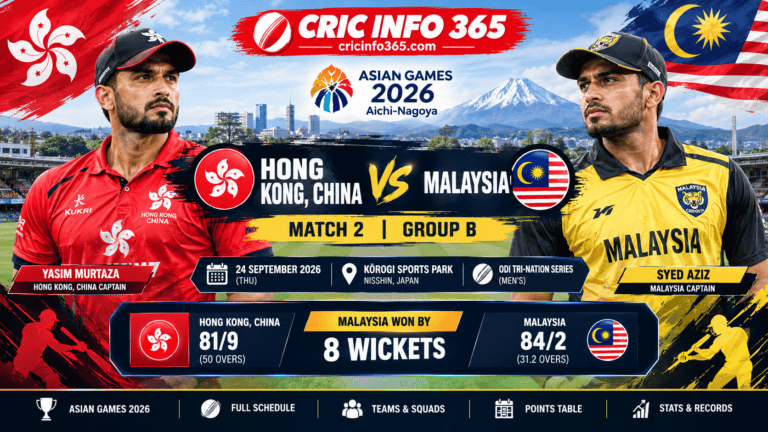
| September 24, Thursday | Hong Kong China vs Malaysia | Group B |
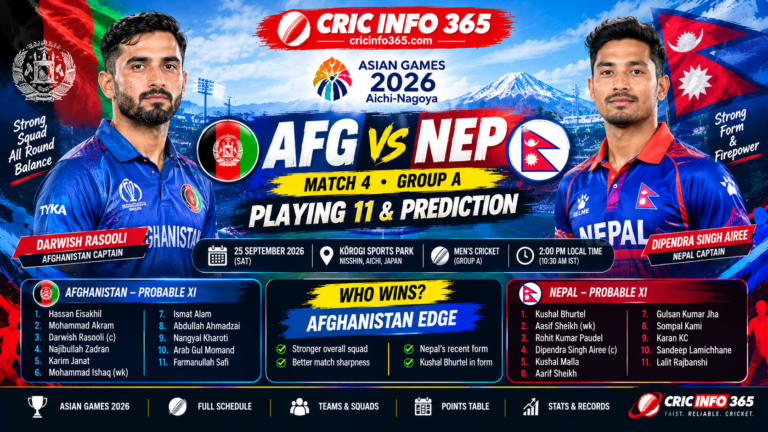
| September 25, Friday | Afghanistan vs Nepal | Group A |
| September 25, Friday | Hong Kong China vs Oman | Group B |
| September 26, Saturday | Japan vs Nepal | Group A |
| September 26, Saturday | Malaysia vs Oman | Group B |
Afghanistan is the obvious favorite to top Group A given the gap in T20I experience between them and Japan or Nepal, but Nepal are not a soft touch. They won the Asian Games qualifier tournament outright in Singapore back in May and June, beating Hong Kong in the final, so they arrive with genuine form rather than just a participation spot.
Group B is closer to a toss up. Hong Kong finished runners up at that same qualifier, Oman have steady white ball depth from years on the ICC circuit, and Malaysia will lean on home continent conditions being at least somewhat familiar compared to the other associate sides.
What Is the Full Quarterfinal, Semifinal and Final Schedule?
Once the groups wrap up on September 26, the tournament moves fast. Here is how the seeded teams line up against the group qualifiers.
| Round | Date | Fixture | Venue |
|---|---|---|---|
| Quarterfinal 1 | September 28, Monday | Pakistan vs Group B runner up | Nisshin |
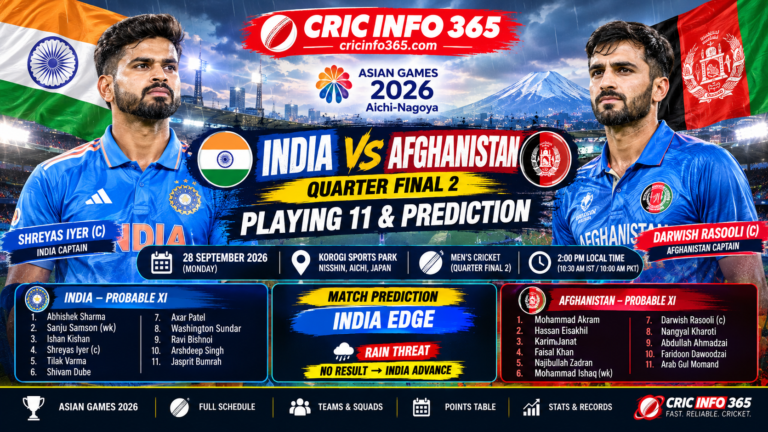
| Quarterfinal 2 | September 28, Monday | India vs Group A runner up | Nisshin |
| Quarterfinal 3 | September 29, Tuesday | Sri Lanka vs Group A winner | Nisshin |
| Quarterfinal 4 | September 29, Tuesday | Bangladesh vs Group B winner | Nisshin |
| Semifinal 1 | October 1, Thursday | Winner QF1 vs Winner QF3 | Nisshin |
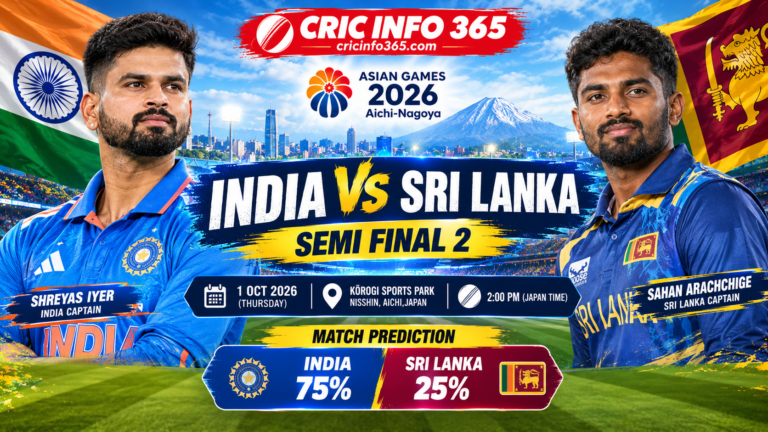
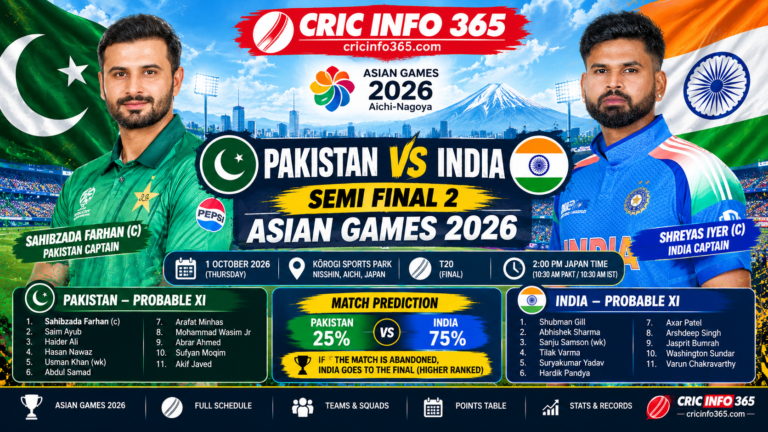
| Semifinal 2 | October 1, Thursday | Winner QF2 vs Winner QF4 | Nisshin |
| Bronze medal match | October 3, Saturday | Losing semifinalists | Nisshin |
| Gold medal match | October 3, Saturday | Winning semifinalists | Nisshin |
Notice that India and Pakistan sit on opposite sides of the bracket. India’s quarterfinal and semifinal path runs through QF2 and SF2, while Pakistan’s runs through QF1 and SF1. That means the two rivals can only meet in the gold medal match itself, not before it, which is exactly how the draw was set up. For live match centre updates as fixtures are confirmed, ESPNcricinfo’s schedule page tracks results round by round.
Why Wasn’t Afghanistan Given a Direct Quarterfinal Spot?
This is the part most previews skip past. Afghanistan is an ICC Full Member, the same status as India, Pakistan, Bangladesh and Sri Lanka, and by that logic you would expect all five to get a bye. They did not, and the reason comes down to a single annual ranking update.
When the ICC released its Men’s T20I rankings update in May 2026, the order among these five nations was India in first place, Pakistan sixth, Bangladesh eighth, Sri Lanka ninth, and Afghanistan tenth. Sri Lanka had actually just dropped to their lowest ever T20I ranking in that same update, slipping below Bangladesh, but they still finished one spot above Afghanistan. When the Asian Games draw used the July 23 rankings snapshot to decide seeding, that order held, and Afghanistan missed the cutoff by the thinnest possible margin.
It is a reminder that Full Member status guarantees entry into these events, not a bye through them. Afghanistan still has arguably the strongest bowling attack of the six group stage teams, built around Karim Janat and a young squad led by Darwish Rasooli, and a group containing only Japan and Nepal should be very winnable. But they will have to beat both to even reach the knockout stage that four other Full Members walked into automatically.
Squads for the Seeded Teams
All ten men’s squads, as they have been announced, are tracked in detail by the International Cricket Council, which is worth checking for any late changes before the tournament starts.
India
Shreyas Iyer captains India’s most senior squad for this event yet, with world number one and two T20I batters Abhishek Sharma and Ishan Kishan both included, plus 15 year old Vaibhav Sooryavanshi fresh off an eye catching IPL 2026. Yash Thakur was added late as a replacement after Harshit Rana picked up a rectus femoris strain.
| Batsmen | Bowlers | All Rounders | Wicketkeepers |
|---|---|---|---|
| Shreyas Iyer (c) | Jasprit Bumrah | Shivam Dube | Sanju Samson |
| Abhishek Sharma | Arshdeep Singh | Axar Patel | Ishan Kishan |
| Tilak Varma (vc) | Yash Thakur | Washington Sundar | |
| Vaibhav Sooryavanshi | Varun Chakaravarthy | Nitish Kumar Reddy | |
| Ravi Bishnoi |
Pakistan
This is a younger, middle order heavy squad built around Sahibzada Farhan’s captaincy rather than around the usual senior names. Four uncapped players, Akif Javed, Ali Raza, Maaz Sadaqat and Saad Masood, are in line for their first T20I appearances, which says Pakistan is treating this as a chance to test bench strength ahead of 2028.
| Batsmen | Bowlers | All Rounders | Wicketkeepers |
|---|---|---|---|
| Sahibzada Farhan (c) | Abrar Ahmed | Abdul Samad (vc) | Usman Khan |
| Haider Ali | Ahmed Daniyal | Saad Masood | |
| Hasan Nawaz | Akif Javed | ||
| Saim Ayub | Ali Raza | ||
| Maaz Sadaqat | Mohammad Salman Mirza | ||
| Arafat Minhas | Sufyan Moqim |
Bangladesh
A settled, experienced pace attack is the standout feature here, with Mustafizur Rahman and Shoriful Islam both included alongside Hasan Mahmud, plus a genuine spin bowling all round option in Rishad Hossain and Mahedi Hasan.
| Batsmen | Bowlers | All Rounders | Wicketkeepers |
|---|---|---|---|
| Tanzid Hasan | Nasum Ahmed | Musaddek Hossain Saikat | Litton Das (c) |
| Parvez Hossain Emon | Shoriful Islam | Rishad Hossain | |
| Mohammed Saif Hasan | Mustafizur Rahman | Mahedi Hasan | |
| Najmul Hossain Shanto | Hasan Mahmud | Mohammed Saifuddin | |
| Tawhid Hridoy (vc) | |||
| Yasir Ali Chowdhury |
Sri Lanka
Sri Lanka goes in with a first choice captain, off-spinning all-rounder Sahan Arachchige, who is not their regular international skipper, which suggests the board wants a fresh voice tested in a lower pressure event before any senior role changes. Only 14 of the 15 squad members had been confirmed in reporting at the time of writing.
| Batsmen | Bowlers | All Rounders | Wicketkeepers |
|---|---|---|---|
| Lasith Croospulle | Binura Fernando | Sahan Arachchige (c) | Niroshan Dickwella |
| Nuwanidu Fernando | Tharindu Hansaka | Ashen Bandara | Sohan de Livera |
| Sineth Jayawardena | Dushan Hemantha | ||
| Pramod Madushan | Chamika Karunaratne | ||
| Wanuja Sahan | |||
| Nuwan Thushara |
Squads for the Group Stage Teams
Afghanistan
A young group with Najibullah Zadran and Karim Janat as the senior heads guiding a squad that features six uncapped players. Darwish Rasooli, who has captained Afghanistan once before, leads the side.
| Batsmen | Bowlers | All Rounders | Wicketkeepers |
|---|---|---|---|
| Darwish Rasooli (c) | Farmanullah Safi | Ismat Alam | Mohammad Ishaq |
| Mohammad Akram | Arab Gul Momand | Karim Janat | |
| Hassan Eisakhil | Faridoon Dawoodzai | Nangyal Kharoti | |
| Khalid Taniwal | Abdullah Ahmadzai | ||
| Faisal Khan | Imran Mir | ||
| Najibullah Zadran |
Nepal
Kushal Bhurtel arrives as the form batter of the qualifying tournament, having scored 340 runs there and passed 2,000 T20I career runs along the way. Dipendra Singh Airee, nicknamed “The Tiger” for his all-round ability, captains the side.
| Batsmen | Bowlers | All Rounders | Wicketkeepers |
|---|---|---|---|
| Rohit Kumar Paudel | Karan KC | Dipendra Singh Airee (c) | Aasif Sheikh |
| Kushal Bhurtel | Sandeep Lamichhane | Sompal Kami | |
| Lokesh Bam | Lalit Rajbanshi | Aarif Sheikh | |
| Sundeep Jora | Nandan Yadav | Gulsan Kumar Jha | |
| Sher Malla | Kushal Malla |
Japan
As hosts, Japan get an automatic spot regardless of ranking. Kendel Kadowaki-Fleming, the country’s all-time leading T20I run-scorer, captains a squad that blends domestically developed players with those of mixed heritage backgrounds. Confirmed roles are limited to what Japan Cricket Association and ICC reporting has specified: Wataru Miyauchi and Alex Shirai-Patmore keep wicket, Makoto Taniyama is Japan’s leading wicket-taker as a leg-spinner, Jake Kusuda-Nairn is a spin bowling all-rounder, and Tsuyoshi Takada is a medium pacer. Full role breakdowns for the remaining squad members were not publicly available at the time of writing.
Full squad: Kendel Kadowaki-Fleming (c), Charlie Hara-Hinze, Benjamin Ito-Davis, Alester Kadowaki-Fleming, Kohei Kubota, Jake Kusuda-Nairn, Wataru Miyauchi (wk), Reo Sakurano-Thomas, Alex Shirai-Patmore (wk), Shoma Sugaya-Slater, Declan Suzuki-McComb, Tsuyoshi Takada, Ibrahim Takahashi, Makoto Taniyama, Lachlan Yamamoto-Lake
Oman
Oman qualified through the Singapore qualifier and are captained by Sufyan Mehmood. Individual playing roles for this squad have not been published in the reporting available at the time of writing, so it is listed here as a full squad rather than broken out by role.
Full squad: Sufyan Mehmood (c), Muzaffar Shiralkar, Mohammed Ali Al Balushi, Zubair Al Balushi, Shuaib Al Balushi, Nawed Al Balushi, Wasim Al Balushi, Ahmed Al Zadjali, Sameer Othman, Waheed Al Balushi, Faris Al Balushi, Mohammed Osman, Issa Rahim Al Balushi, Abdul Jalil, Qais Al Balushi
Hong Kong China and Malaysia
Both squads were finalized later than the other eight and had not been fully published in detail at the time of writing. Hong Kong reached the final of the qualifying tournament in Singapore, so expect a squad built around that core group, with players like Aaron Varghese having featured there. Check back closer to September 24 for the confirmed lists.
How Did Teams Qualify for This Tournament?
The ten spots were filled through three separate routes. Japan got in automatically as hosts, one spot. The five ICC Full Member nations from Asia, India, Pakistan, Bangladesh, Sri Lanka and Afghanistan, qualified directly by virtue of that status, five spots. The remaining four spots went through the 2026 Men’s Asian Games Qualifier, held in Singapore from May 31 to June 8.
Seven teams competed for those four places in a round robin followed by knockouts. Nepal won the whole thing, going unbeaten and finishing with the best net run rate in their group by a wide margin. Hong Kong finished runners up. Malaysia and Oman rounded out the four qualifiers. Kushal Bhurtel of Nepal was named player of the tournament after scoring 340 runs, and the bowling honors were shared between Ehsan Khan and Vijay Unni with 11 wickets each.
How Has Cricket Done at Past Asian Games?
This is the fourth Asian Games to include cricket, and the medal table so far tells its own story.
| Edition | Gold | Silver | Bronze | Notes |
|---|---|---|---|---|
| 2010 Guangzhou | Pakistan | Bangladesh | Sri Lanka | 8 teams |
| 2014 Incheon | Pakistan | Bangladesh | Sri Lanka | 10 teams |
| 2023 Hangzhou | India | Afghanistan | Bangladesh | 9 teams, final washed out |
Pakistan and India are tied on two golds each across the history of the event, but Bangladesh has quietly built the deepest overall medal cabinet with one gold, two silvers and three bronzes across the three editions, six medals in total. Sri Lanka has three medals, and Afghanistan has three silvers without ever winning gold, including the 2023 final that they lost only on seeding after rain wiped out the actual match.
That washed out final is worth remembering going into this edition. India were awarded gold over Afghanistan in Hangzhou purely because they held the higher seed when no result could be forced, not because they won a cricket match. It is a slightly unsatisfying way to decide a gold medal, and it is part of why the format tweaks for 2026, fewer byes, a tighter qualifying window, feel like a deliberate response to that outcome.
Why This Asian Games Matters More Than Usual
The biggest difference between this edition and Hangzhou 2023 has nothing to do with the bracket. It is squad selection. In 2023, the Asian Games overlapped with ICC World Cup preparation, so several boards, India included, sent understrength squads and rested their biggest names. This time there is no such clash on the calendar, and India’s own squad announcement made the point directly: with cricket confirmed for the Los Angeles 2028 Olympics, this tournament is being treated as a genuine dry run rather than a scheduling afterthought.
That shows up clearly in personnel. India has picked a squad captained by their actual T20I captain, Shreyas Iyer, featuring Jasprit Bumrah and both of the world’s top two ranked T20I batters. Pakistan, Bangladesh and Sri Lanka have all sent squads built around players who are realistic first choice picks, not just reserves getting game time. Four members of India’s 2023 gold winning squad, Shivam Dube, Tilak Varma, Arshdeep Singh and Ravi Bishnoi, are back, but this time surrounded by even more senior support.
The stakes are bigger too. Olympic qualification for LA 2028 runs through regional automatic slots, and while the Asian Games result itself does not hand out an Olympic berth, every multi sport event between now and 2028 is being watched as a proof of concept for how boards balance bilateral cricket against Olympic ambitions. A strong, high profile Asian Games in Aichi Nagoya makes the case for taking Olympic cricket seriously. A flat, underattended one would do the opposite.
Where Can You Watch the Matches?
Broadcast and streaming rights for the Asian Games 2026 cricket competition are being handled on a region by region basis rather than through a single global broadcaster, similar to how the 2023 Hangzhou Games were distributed. Fans in India, Pakistan, Bangladesh and Sri Lanka should expect coverage through their usual national cricket broadcasters and streaming apps, alongside the official Olympic Council of Asia digital channels for wider Games coverage. Local listings will firm up closer to September 24, so check your regional sports broadcaster or streaming service in the days before the tournament starts.
FAQs
-
When does the Asian Games 2026 cricket tournament start and end?
The men’s tournament runs from September 24 to October 3, 2026, at Korogi Sports Park in Nisshin, Aichi Prefecture, Japan. It sits inside the wider Asian Games, which runs September 19 to October 4.
-
Which teams are seeded directly into the quarterfinals?
India, Pakistan, Bangladesh and Sri Lanka, based on their positions in the ICC Men’s T20I Team Rankings as of the July 23, 2026 draw date. All four skip the group stage entirely.
-
How do the two preliminary groups work?
Afghanistan, Japan and Nepal make up Group A. Hong Kong China, Malaysia and Oman make up Group B. Each group plays a single round robin from September 24 to 26, and the top two teams from each group advance to the quarterfinals.
-
Why wasn’t Afghanistan given a direct quarterfinal spot despite being an ICC Full Member?
Afghanistan ranked tenth among these nations in the May 2026 ICC T20I rankings update, one place behind Sri Lanka, who took the fourth and final seeded spot. Full Member status guarantees entry into the tournament, not automatic seeding.
-
Can India and Pakistan meet before the final?
No. The draw places them on opposite sides of the knockout bracket, so the earliest they can face each other is the gold medal match on October 3.
-
Who are the defending champions?
India won gold in the men’s event at Hangzhou 2023, though that final against Afghanistan was actually washed out by rain and decided by seeding rather than a completed match.
-
Is this the same squad strength as the last Asian Games?
No, and that is one of the bigger stories around this edition. Most major boards, including India, sent understrength squads to Hangzhou 2023 because of a scheduling clash with World Cup preparation. With no such clash in 2026 and cricket now part of the LA 2028 Olympics, nearly every team has picked a full strength squad this time.
-
Where can I watch the Asian Games 2026 cricket matches?
Coverage is split by region rather than through one global broadcaster. Check your national cricket broadcaster or streaming service, along with official Olympic Council of Asia channels, for confirmed listings closer to September 24.
Final Word
The format this year is tighter than it looks on paper. Four seeded teams skip straight to the last eight, six teams fight through two brutal three team groups, and India and Pakistan cannot cross paths until the gold medal match itself. Add in the fact that almost every board has sent its best available squad for the first time at this event, and Aichi Nagoya has a real chance to be the most competitive Asian Games cricket tournament yet, not just the biggest.
For live scores, squad updates and match reports as the tournament unfolds, keep this page bookmarked.
This coverage is brought to you by CRIC INFO 365 — designed for passionate cricket fans seeking fast, reliable live scorecards, comprehensive match reports, and in-depth analysis for every Test, ODI, and T20 cricket match as it happens, ensuring you never miss a moment of the action.
12 Comments