By CRIC INFO 365 Staff | September 21, 2026
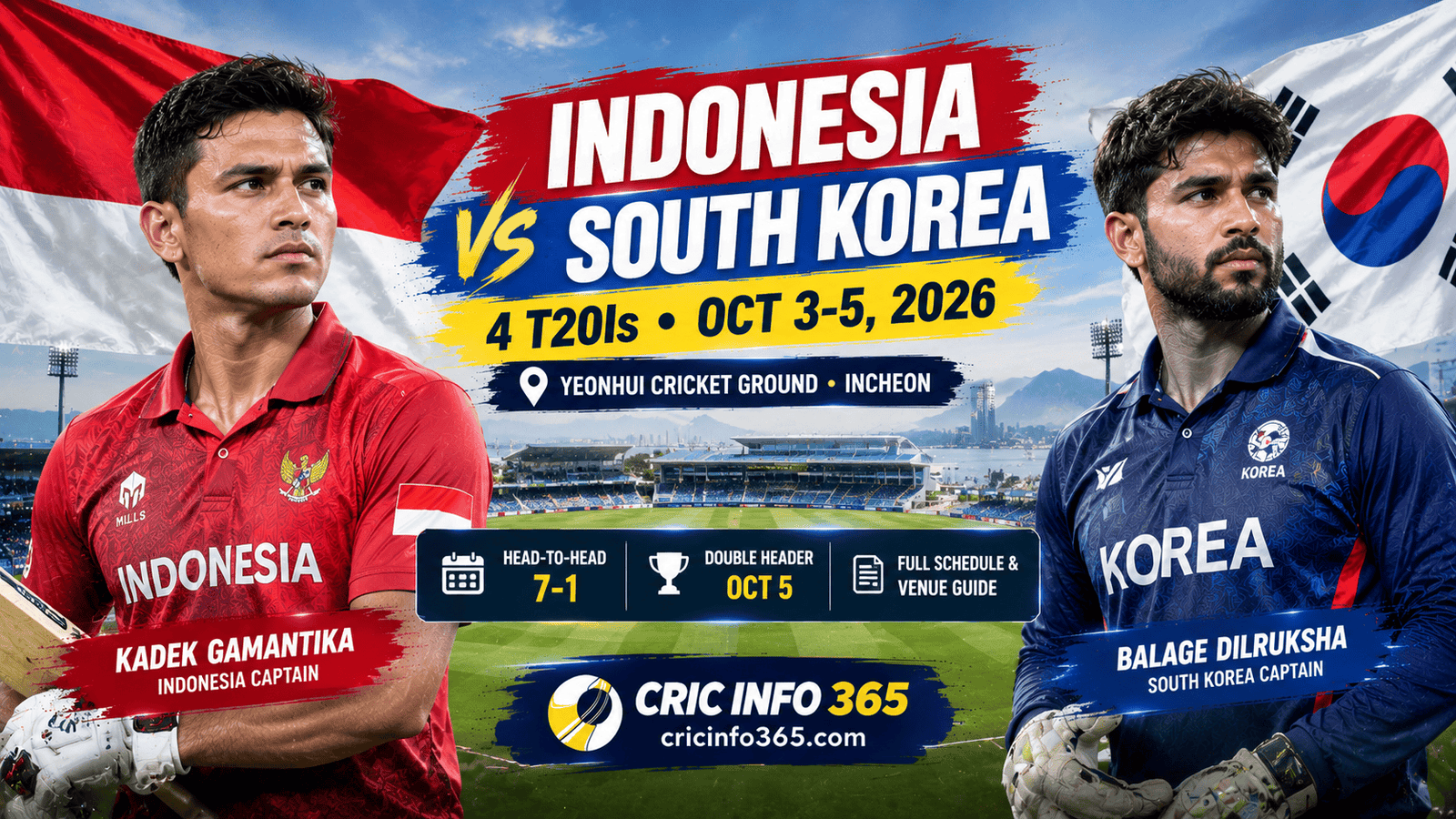
Indonesia Tour of South Korea 2026 from October 3 to October 5, 2026, for four T20Is, all played at the Yeonhui Cricket Ground in Incheon. It is a short, compact series squeezed into three days, including a double header on the final day. Beyond the fixtures, this is a rivalry with more history than its low profile suggests, going all the way back to both nations’ first ever international match.
Here is the full schedule, the background on both teams, and why this series is worth more than a passing glance.
When and Where Are the Matches?
All four matches are played at a single venue, which is standard practice for associate nation bilateral series where travel budgets and ground availability are tighter than at the international level most fans follow closely.
| # | Match | Date | Venue | Local Time |
|---|---|---|---|---|
| 1 | 1st T20I | October 3, 2026 | Yeonhui Cricket Ground, Incheon | 10:00 AM |
| 2 | 2nd T20I | October 4, 2026 | Yeonhui Cricket Ground, Incheon | 10:00 AM |
| 3 | 3rd T20I | October 5, 2026 | Yeonhui Cricket Ground, Incheon | 10:00 AM |
| 4 | 4th T20I | October 5, 2026 | Yeonhui Cricket Ground, Incheon | 2:00 PM |
Playing two matches on the same day on October 5 is a practical scheduling choice rather than an unusual one. Associate nation tours regularly compress fixtures this way to make the most of a short window when both squads are already assembled and traveling is otherwise difficult to justify for a longer stay, particularly for two boards operating on the tighter budgets typical of associate member programs.
Yeonhui Cricket Ground itself has hosted international cricket since South Korea’s earliest T20I matches, and it remains the country’s primary venue for the format, having also staged the 2024 East Asia-Pacific Sub-regional Qualifier when South Korea last hosted a multi team tournament. Playing all four matches of this series at a single, familiar ground gives South Korea a genuine, if historically underused, home advantage.
What’s the Format of This Series?
Four T20Is is a fuller allocation than many bilateral series between associate nations get, which usually run to two or three matches. That extra match matters for a series like this one, since it gives both squads a genuine chance to rotate personnel and test fringe players across four completed games rather than a shorter, higher variance set.
This tour also lands inside a busy period for East Asia-Pacific cricket. It follows closely behind the region’s men’s T20 World Cup qualifying campaign earlier in the year, and both Indonesia and South Korea have been playing a heavier international schedule in 2026 than in previous years as the region’s cricket boards push to develop their national programs. Neither board has confirmed this specific series as carrying any official ranking or qualification stakes, but it functions as valuable match practice inside a calendar that is only getting busier for teams at this level.
For a look at how Japan, the region’s most developed program, fits into this same broader picture, our India vs Japan 2026 T20I guide and squads covers Japan’s own recent build up in detail.
Who Are Indonesia and South Korea in World Cricket?
Indonesia are captained by Kadek Gamantika and currently sit 63rd in the ICC’s T20I team rankings, having reached as high as 47th back in November 2022. They earned Associate membership status in 2017, building on Affiliate status that dates back to 2001. Indonesia’s overall T20I record stands at 115 matches played, with 51 wins against 61 losses, a tie and two no results, though 2026 alone has been a tougher year, with just 4 wins from 21 matches against a broader, stronger set of opponents than the team usually faces.
South Korea are captained by Balage Dilruksha and sit lower in the T20I rankings at 77th, with a best ever ranking of 64th back in May 2019. Like Indonesia, they hold Associate status since 2017. Their overall T20I record is 24 matches, 5 wins and 19 losses, though 2026 has actually been their strongest year yet relative to history, with 3 wins from 6 matches played.
Both programs remain heavily reliant on the same pool of experienced regulars match after match. For Indonesia, that means senior figures like Anjar Tadarus, Gede Priandana and wicketkeeper Ahmad Ramdoni, alongside a promising newer name in Kavin Chaddha, who has scored over 450 runs since debuting in 2026. Official squads for this specific tour had not been announced at the time of writing, which is typical for a series still two weeks away at this level of the sport.
| Player | Team | Why He Matters |
|---|---|---|
| Kadek Gamantika | Indonesia | Captain and long time senior player, with over 1,100 T20I runs and 64 wickets across his career, one of only a handful of genuine all format contributors in the squad |
| Gede Priandana | Indonesia | Indonesia’s most consistent batter by output, with eight fifties from 90 matches, the closest thing the side has to a reliable top order anchor |
| Kavin Chaddha | Indonesia | The squad’s newest breakout name, averaging over 26 with a top score of 75 not out since debuting earlier this year |
| Balage Dilruksha | South Korea | Captain of a squad built significantly around naturalized and diaspora players, a common pattern for developing cricket nations without a deep domestic playing base |
| Ferdinando Banunaek | Indonesia | The side’s leading wicket taker among regular contributors, with 96 wickets across 105 appearances |
Indonesia’s squad composition also tells its own story about how the sport is developing in the country. A domestic playing base built mainly around expatriate Indian and Sri Lankan communities in earlier years has gradually broadened, and results like the 2023 Southeast Asian Games medal haul, four cricket medals across the men’s and women’s programs, point to a system that is investing in the sport well beyond just the senior men’s T20I side.
What Does the Head to Head Record Say?
Indonesia have dominated this specific matchup, winning 7 of the 8 T20Is played between the two nations, with South Korea’s only win coming as recently as July 2025. That is a lopsided record even by the standards of two closely ranked associate sides, and it is worth remembering heading into this series given how much more competitive South Korea’s overall form has looked in 2026.
The real story here, though, is not the scoreline. It is the shared origin. Indonesia and South Korea played each other in their first ever international match, on the same day, February 25, 2002, in Perth, Australia. Neither side had a T20I to their name at that point, since the format did not exist for associate nations until years later, but the two programs effectively grew up together, meeting as each other’s first opponent on the very day both nations’ cricket histories began. Few rivalries anywhere in the world can trace their first meeting back to literally the first day either side played international cricket at all.
Both sides went on to make their T20I debuts against each other too, twenty years later, at the Sano International Cricket Ground in Japan in October 2022, Indonesia playing their first T20I on October 9 and South Korea following with theirs on October 15 of the same month. That means this rivalry has now marked three separate landmark moments for both programs, their first ever international match, their first T20Is, and now a rare four match bilateral series that gives both sides more time together on the field than almost any previous meeting.
How Did Both Teams Fare in This Year’s World Cup Qualifying?
Both nations featured in the 2026 Men’s T20 World Cup East Asia-Pacific Sub-regional Qualifier, hosted by Japan in May, and their campaigns tell two very different stories.
Indonesia had a genuinely encouraging tournament. They opened by beating the Philippines by 11 runs, then advanced through to the Super Six stage as one of the top two teams in their group, before eventually falling to eventual runners-up Japan by 41 runs. Reaching the Super Six from a group of nine competing nations is a solid result and points to a squad capable of holding its own against the region’s stronger programs on its day.
South Korea’s tournament ended almost as soon as it began. They lost their opening group match to the Cook Islands by 9 wickets after being bowled out for just 47, a result that reflects how far the gap still runs between South Korea and the region’s more established sides. It is also not an isolated bad day. When South Korea hosted their own qualifying tournament back in 2024, also at Yeonhui Cricket Ground in Incheon, they finished bottom of the four team group without a single win in six matches, a losing streak that makes home advantage look almost irrelevant for this program so far.
International Cricket Council coverage of that May qualifying tournament has the full breakdown of how both sides’ campaigns actually played out.
What Storylines Should You Watch For?
Given the gap in recent qualifying results, the most interesting question of this series is whether South Korea’s improved 2026 bilateral form, 3 wins from 6 matches this year, was a genuine step forward or simply a product of playing weaker opposition than they faced in May. A home series against Indonesia, a side they have historically struggled against far more than most opponents, is a fair test of that question.
For Indonesia, the storyline is about squad depth. With Kavin Chaddha’s emergence this year and a settled senior core built around Gamantika and Priandana, this series is an opportunity to build combinations ahead of whatever comes next in the region’s qualifying pathway, rather than simply banking on a head to head record that already heavily favors them. How much of the squad that reached the Super Six in May gets rotated through across four matches, rather than the same core XI playing every game, will say a lot about how deep the board believes its talent pool actually runs.
More broadly, series like this one matter for a reason that goes beyond the scoreline. Regular, well organized bilateral cricket between associate nations is exactly what turns occasional qualifying tournament appearances into genuinely competitive programs over time, and a four match series with a double header finish is a meaningful step in that direction for both boards. Our Asian Games 2026 cricket schedule and squads guide covers the wider Asian cricket calendar this series sits inside, including how Japan’s own hosting commitments this year connect to the same regional development push.
Indonesia’s wider 2026 calendar also gives useful context for how they might approach this series. They played an eight match T20I series against Sweden in April, losing all but one game, and further fixtures against Uzbekistan in June, results that show a board committed to playing frequently even when the results are not flattering. That volume of cricket, four times as many matches this year as South Korea have played, could cut either way here. It may mean Indonesia arrive undercooked from a difficult year, or it may mean they simply have more recent match sharpness to draw on than a South Korean side who have played far less cricket overall.
Where to Watch
Broadcast and streaming details for associate nation bilateral series like this one are typically confirmed much closer to the fixtures than they are for major international cricket, often through the Korea Cricket Association or Cricket Indonesia’s own digital channels rather than a major broadcaster. ESPNcricinfo tracks the fixture list and scorecards as they are confirmed, which is the most reliable place to check for updates closer to the series.
FAQs
-
When does the Indonesia tour of South Korea 2026 start?
October 3, 2026, with the tour running through October 5, 2026.
-
How many matches are being played and where?
Four T20Is, all at the Yeonhui Cricket Ground in Incheon, including two matches on the final day, October 5.
-
Who captains each side?
Kadek Gamantika captains Indonesia. Balage Dilruksha captains South Korea.
-
What is the head to head record between Indonesia and South Korea?
Indonesia lead 7 wins to 1 from 8 previous T20I meetings. The two nations also played each other in their first ever international match, on the same day, February 25, 2002.
-
Does this series carry any World Cup qualification points?
Neither board has confirmed official qualification stakes for this specific series, though both nations remain active in the broader East Asia-Pacific development pathway following May’s qualifying tournament in Japan.
-
How did both teams perform in this year’s qualifying tournament?
Indonesia reached the Super Six stage before losing to Japan. South Korea were eliminated after their opening match, losing to the Cook Islands by 9 wickets.
-
Where can I watch the matches?
Check the Korea Cricket Association and Cricket Indonesia’s official channels closer to the series, along with ESPNcricinfo for confirmed fixture and streaming details.
Final Word
A four match T20I series between two associate nations rarely makes headlines, but this one carries a genuinely unusual thread running through it. Indonesia and South Korea have been playing each other, in some form, since the very first day either country fielded an international cricket side.
The head to head record heavily favors Indonesia, and South Korea’s poor history at this exact venue during their own hosted qualifying tournament in 2024 is not an encouraging sign, but a home side with improved 2026 form and a shorter, sharper series to work with has every reason to believe this is the year that record starts to shift. For a program with as few wins on the board as South Korea’s, four matches in three days is as good a chance as any to find out.
This coverage is brought to you by CRIC INFO 365 — designed for passionate cricket fans seeking fast, reliable live scorecards, comprehensive match reports, and in-depth analysis for every Test, ODI, and T20 cricket match as it happens, ensuring you never miss a moment of the action.