By the Cric Info 365 Editorial Team | September 19, 2026
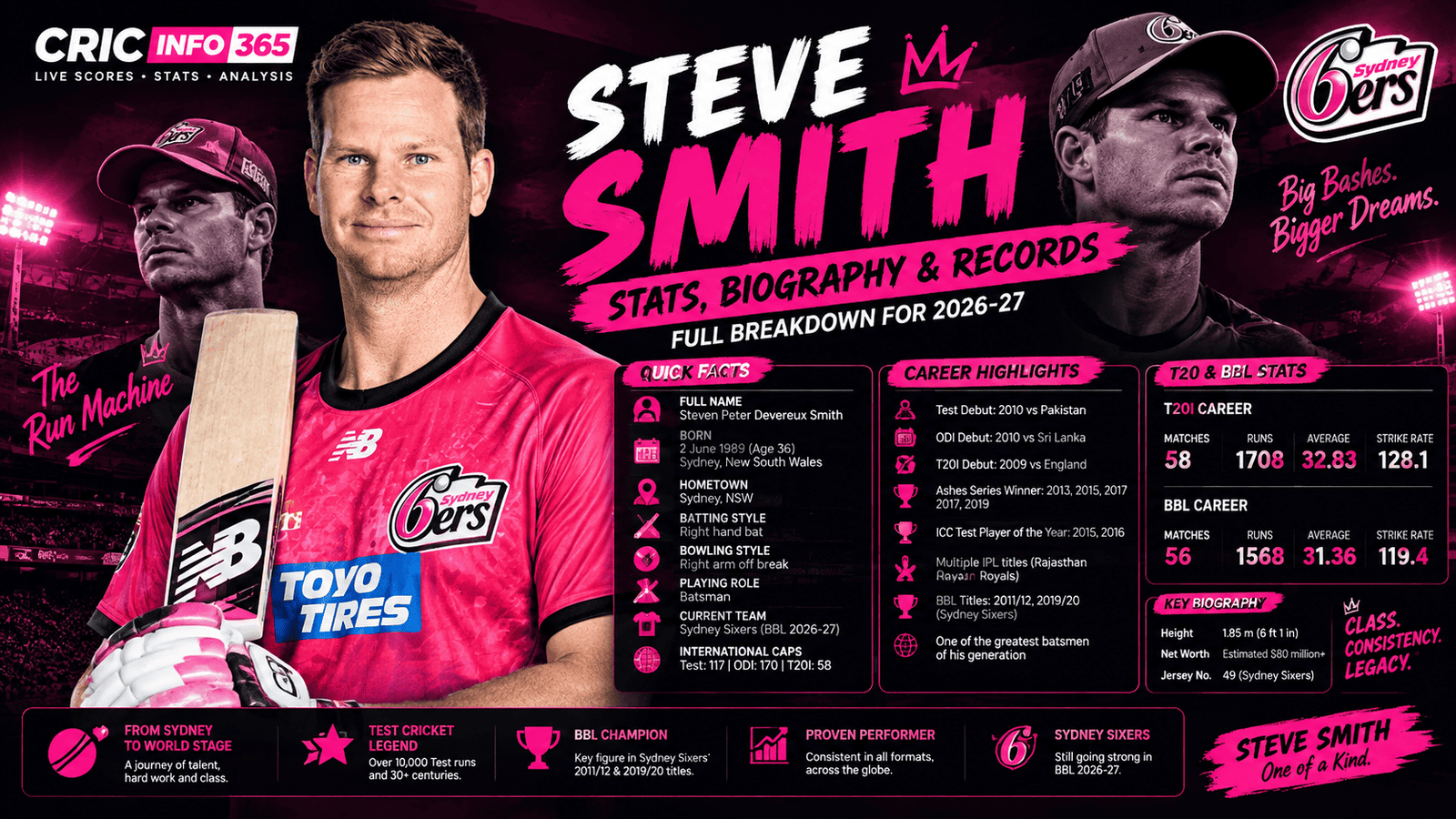
Steve Smith is 37, stands about 5 ft 8 in to 5 ft 9 in, and is usually valued at around US$30 million. He has scored 10,920 Test runs at 56.00, and in the Big Bash League he averages 48.32 at a strike rate of 150.85. That BBL record is better than anything he has produced in the IPL or PSL.
This guide covers his international numbers, his domestic and franchise record, his height, his money, and what to expect when he returns for the Sydney Sixers in BBL 16. Every table comes with an explanation, because a stat line on its own rarely tells you what kind of player you are looking at. [internal link: Steve Smith Test career and Ashes record]
Quick Answer: Steve Smith in Six Lines
- International stats: 10,920 Test runs at 56.00 with 37 hundreds, 5,800 ODI runs at 43.28, and 1,094 T20I runs at 24.86.
- BBL career: 1,498 runs at 48.32, strike rate 150.85, four hundreds, highest score 125 not out.
- Height: About 173 to 176 cm (5 ft 8 in to 5 ft 9 in), depending on the source.
- Net worth: Estimated at US$30 million, with published ranges from US$25 million to US$35 million.
- Status: Active in Tests, retired from ODIs in March 2025, last T20I in February 2024.
- 2026/27: Listed among the Sydney Sixers’ contracted players for BBL 16.
Steve Smith Biography at a Glance
| Detail | Information |
|---|---|
| Full name | Steven Peter Devereux Smith |
| Nickname | Smudge |
| Born | 2 June 1989, Kogarah, New South Wales |
| Age | 37 |
| Batting | Right handed |
| Bowling | Right-arm leg-break |
| Role | Top order batter |
| Height | About 173 to 176 cm (5 ft 8 in to 5 ft 9 in) |
| Shirt number | 49 |
| Debuts | T20I 5 February 2010 v Pakistan, ODI 19 February 2010 v West Indies, Test 13 July 2010 v Pakistan |
| Current international status | Active in Tests, last ODI 4 March 2025, last T20I 25 February 2024 |
One thing that table hides: all three international debuts came within about five months of each other in 2010, T20I first, ODI second, Test last. Smith started as a leg spinner and grew into a top-order batter, which is why his bowling numbers exist at all and why his technique still looks a little homemade. That background explains much of what follows.
Which Teams Has Steve Smith Played For?
| Team | Competition | Years |
|---|---|---|
| Australia | International | 2010 to present |
| New South Wales | Sheffield Shield and Marsh Cup | 2007/08 to present |
| Sydney Sixers | BBL | 2011/12 to present |
| Worcestershire | English county cricket | 2010 |
| Pune Warriors | IPL | 2012 to 2013 |
| Rajasthan Royals | IPL | 2014 to 2015 and 2019 to 2020 |
| Rising Pune Supergiant | IPL | 2016 to 2017 |
| Barbados Tridents | CPL | 2018 |
| Toronto Nationals | Global T20 Canada | 2018 |
| Comilla Victorians | BPL | 2019 |
| Multan Sultans | PSL | Recent seasons |
| Washington Freedom | MLC | Recent seasons |
He has also had a brief spell at Sussex, and this list is not complete. It covers the stints we could verify.
Read the list as a pattern, not a stat box. Smith has played T20 cricket in India, the Caribbean, Canada, Bangladesh, Pakistan, the United States and England, yet his two long relationships are with New South Wales and the Sixers. He has also played just 40 BBL games across 15 seasons at the Sixers, roughly 2.7 a summer. That is the key to reading his BBL record: it is a small sample built in short bursts between international duty, so every innings carries weight.
What Are Steve Smith’s International Stats?
A quick note before the numbers. The figures below come from tables compiled from ICC, CricketArchive, and Cricinfo data. A small gap after his latest series is possible, so check Cricinfo for live totals.
Batting
| Format | Matches | Innings | Runs | Highest Score | Average | 100s / 50s |
|---|---|---|---|---|---|---|
| Test | 125 | 223 | 10,920 | 239 | 56.00 | 37 / 45 |
| ODI | 170 | 154 | 5,800 | 164 | 43.28 | 12 / 35 |
| T20I | 67 | 55 | 1,094 | 90 | 24.86 | 0 / 5 |
Bowling and Fielding
| Format | Balls Bowled | Wickets | Best Bowling | Average | Catches |
|---|---|---|---|---|---|
| Test | 1,470 | 19 | 3/18 | 53.05 | 219 |
| ODI | 1,076 | 28 | 3/16 | 34.67 | 90 |
| T20I | Not listed | 17 | 3/20 | 22.17 | 41 |
How Good Are His Test Numbers?
Very good, and better than a plain average suggests. Divide 10,920 runs by an average of 56.00, and you get 195 dismissals. That means 28 of his 223 innings ended not out. A hundred has arrived roughly once every six innings, and 82 of those 223 innings reached fifty or more, about 37 percent. Few batters turn starts into big scores that often.
The Bradman comparison follows Smith around, and it is fun, but only up to a point. Bradman averaged 99.94, and nobody else is close. The fairer comparison is with the modern group of Joe Root, Virat Kohli and Kane Williamson, and against those names Smith holds his own comfortably.
His fielding deserves more credit than it gets. He has 219 catches in 125 Tests, which is 1.75 per match. For a specialist batter, that is a serious contribution, and most of it comes from the slip cordon. His bowling is a footnote now. He started as a leg spinner and has 19 Test wickets, one every 77 balls or so, at 53.05. Those 1,470 balls remind us he came into the side as a bowler who could bat. [internal link: Australia Test squad and slip cordon analysis]
What About His ODI Record?
Smith played 170 ODIs before retiring from the format after his last game on 4 March 2025 against India. He made 5,800 runs at 43.28, with 12 hundreds and 35 fifties. Twelve hundreds in 154 innings works out to one every 12.8 innings, which is a strong return in a format where scoring is rarely easy for a batter who builds an innings.
The average is nearly 13 runs lower than in Tests. That is normal for a player whose game is built on time at the crease. It also means 20 of his ODI innings ended not out, so he finished games as well as he started them.
And His T20I Record?
This is the awkward part of his career sheet. In 67 T20Is, he scored 1,094 runs at 24.86, with a best of 90 and no hundred. His last T20I was against New Zealand on 25 February 2024. His bowling in the format was better than expected, with 17 wickets at 22.17.
Here is the twist. His T20I average is roughly half his BBL average. My reading is that it comes down to role. For Australia, he was moved around and asked to fit in with others. For the Sixers, he opens, gets first use of the powerplay, and has a fixed job. Franchise cricket at home gave him freedom that international T20 rarely did.
What Do Smith’s Domestic Numbers Tell Us?
| Category | Matches | Runs | Batting Average | 100s / 50s | Wickets | Bowling Average | Catches |
|---|---|---|---|---|---|---|---|
| First class | 190 | 15,776 | 54.21 | 54 / 68 | 72 | 51.80 | 315 |
| List A | 220 | 7,873 | 46.31 | 15 / 50 | 47 | 39.14 | 119 |
These records cover his time with New South Wales in the Sheffield Shield and Marsh Cup, plus short stints in English county cricket, Sussex among them.
Here is where it gets interesting. Smith has 190 first-class matches and 125 of them are Tests. Take his Test runs out of the first-class total and you are left with 4,856 runs from the other 65 matches. Using the same dismissal maths as before, that comes to an average of about 50.6 outside Tests. So he does not just pile up runs against international bowlers. He has done the same in the Shield, and that is a big part of why his technique has held up over 15 years.
The List A record backs it up. An average of 46.31 with 15 hundreds is excellent for a batter who was never seen as a one-day specialist.
How Has Smith Done in the IPL, PSL and Other T20 Leagues?
| League / Team | Matches | Innings | Runs | Highest Score | Average | Strike Rate | 100s / 50s |
|---|---|---|---|---|---|---|---|
| IPL (multiple teams) | 103 | 93 | 2,485 | 101 | 34.51 | 128.09 | 1 / 11 |
| Big Bash League (Sydney Sixers) | 40 | 39 | 1,498 | 125 not out | 48.32 | 150.85 | 4 / 10 |
| PSL (Multan Sultans) | 11 | 11 | 380 | 106 | 34.54 | 161.70 | 1 / 2 |
Smith was long viewed as a red-ball specialist, and the IPL numbers show why. An average of 34.51 is decent, but a strike rate of 128.09 is modest for the tournament. He scored 26.7 runs per innings there, compared with 38.4 in the BBL.
The PSL sample is small, just 11 innings, but a strike rate of 161.70 is the highest of the three leagues and includes a century of 106. For fans in Pakistan, that is the number worth watching. If he returns to the league, this record suggests he would arrive with a plan for the powerplay.
Recent headlines also show him adding the MLC with Washington Freedom and making his Hundred debut, so his T20 map is getting bigger, not smaller.
What Is Steve Smith’s BBL Record?
The Career Numbers
Two quick definitions for newer fans. Average is runs scored per dismissal, and strike rate is runs scored per 100 balls. A high average with a high strike rate is the hard combination in T20, because most batters trade one for the other.
| Stat | Figure | What It Means |
|---|---|---|
| Matches | 40 | About 2.7 per season across 15 seasons |
| Runs | 1,498 | 37.45 per match, or 38.4 per innings |
| Highest score | 125 not out | His best T20 knock in the table above |
| Average | 48.32 | Higher than his ODI average |
| Strike rate | 150.85 | About 23 points above his IPL rate |
| Hundreds/fifties | 4 / 10 | A 50-plus score every 2.8 innings |
| Not outs | 8 | Worked out from runs divided by average |
| Balls faced | About 990 | Worked out from runs and strike rate |
Two of those figures are ones you will not find on most stat sites. Dividing 1,498 by 48.32 gives 31 dismissals, so he has been not out eight times in 39 innings. He finishes games as well as opening them. And 1,498 runs at 150.85 means he has faced only about 990 balls in the entire competition. That is a lot of runs for very few deliveries.
What Happened in the 2025/26 Season?
Smith’s most recent BBL summer was one of his best. He top-scored in five innings in a row, according to ABC News, and the run included a century, a fifty in a knockout chase and a big score in the Challenger.
The centrepiece was the Sydney derby. Against the Thunder at the SCG, he reached a hundred in 41 balls and finished on 100 off 42, out-scoring David Warner, who made 110 not out for the other side. He took 32 runs off one Ryan Hadley over, which is a new BBL record for a single over, and the Sixers won by five wickets with 16 balls to spare. The full story is in the ESPNcricinfo match report.
A few days later he made 54 at the Gabba in a chase of 172. It was untidy at times, unorthodox as always, but it helped seal a finals place, as Cricket Australia’s site reported. Then came 65 off 43 balls against the Hurricanes in the Challenger, even after he hurt his hand dropping a catch. The Sixers had finished second on the ladder and were chasing a fourth title, but the Perth Scorchers beat them in the final.
Why Does Smith Work as a T20 Opener?
This is analysis, not a stat, but the numbers point one way. Eight not-outs in 39 innings means he rarely gives his wicket away, and a 50-plus score every 2.8 innings means he usually turns a start into something. Opening also gives him the fielding restrictions of the powerplay, when gaps are widest, and his unorthodox scoring areas are hardest to plug. In the middle overs of an international T20I, with a settled field and a required rate to chase, that same style has less room. The tables above fit that story, though other explanations are possible.
Was the Babar Azam Single Moment Right?
It became known as “single gate”. In that derby innings, Smith and Babar Azam put on 141 for the first wicket in 12 overs. At the start of the powerplay surge, Smith turned down a single that would have kept Babar on strike, because he wanted to face the first over of the surge himself.
Fans argued about it for days. Here is my view: he was right. That over went for 32, and it changed the whole chase. Opening partners can disagree, but a captain’s instinct about tempo is worth trusting when a batter is timing the ball like that https://www.sydneysixers.com.au/players/CA:568/mohammad-azam.
Which Format Is Smith Best At?
Ranked by batting average from the tables above:
- Test cricket: 56.00
- First-class cricket: 54.21
- Big Bash League: 48.32
- List A cricket: 46.31
- ODI cricket: 43.28
- PSL: 34.54
- IPL: 34.51
- T20I: 24.86
The BBL sitting third, above his ODI and List A averages, is the surprise. It says the Sixers version of Smith is a different player from the one who plays T20 for Australia. It may also explain the IPL numbers. A strike rate of 128.09 there suggests the role and conditions did not always suit how he scores, though that is an interpretation, not a proven cause.
The gap deserves attention. His BBL average is about 23.5 runs above his T20I average. Wide splits between franchise and country are unusual, and they suggest role and batting position matter more than form for Smith in this format.
How Tall Is Steve Smith?
Steve Smith is about 5 ft 8 in to 5 ft 9 in, which is between 173 and 176 cm. The exact figure depends on who you ask. Wikipedia lists 173 cm, Cricscope says 176 cm, and other stat sites say 5 ft 9 in or 175 cm.
The reason for the spread is simple. Cricketers are rarely measured officially, so sites copy each other or use whatever the player once said. My advice is to treat 5 ft 8 in to 5 ft 9 in as the honest answer.
Does height matter for his batting? Probably less than people assume. Cricscope links his compact frame to a low, balanced base against pace, which is a fair reading of how he shuffles across his stumps. But plenty of taller players score heavily too, so treat height as a curiosity about Smith and not the reason he averages 56.
What Is Steve Smith’s Net Worth?
Most 2026 estimates put Steve Smith’s net worth at around US$30 million. One site gave a range of US$25 million to US$35 million, and an older Man of Many estimate came in at about AU$31 million. A lower figure of US$9 million still floats around online, but it is outdated and should be ignored.
Nobody outside his family can verify the exact number, so these are estimates and not audited totals. What we do know is where the money comes from:
- Cricket Australia contract: One report puts it at around 1.37 million dollars a year, plus match fees.
- IPL earnings: Cricexec, citing SportsTiger, reports about 47.83 crore rupees across his IPL career.
- BBL and other T20 leagues: Contracts with the Sixers and stints in leagues around the world.
- Endorsements: Deals with brands including New Balance and Gillette.
- Koala Mattresses: Man of Many reports that a stake in the mattress company, which he backed as an early brand ambassador, may be the biggest single piece of his wealth.
The 2018 ball tampering ban cost him too. The same Man of Many report says he lost around AU$5 million in endorsements during that period. That makes his recovery, on the field and in business, even more notable.
What Should Fans Expect From Smith in BBL 16?
Smith is listed among the Sixers’ contracted players for 2026/27, according to a squad list from Sportstralia. The same list shows Moises Henriques’ captaincy future and Mitchell Starc’s next move as unresolved, so the group around him may look different by the time the season starts. [internal link: Sydney Sixers BBL 16 squad guide]
Here are four forecasts, and they are my own estimates, not official numbers.
1. A fifth BBL hundred is more likely than not. He has four hundreds in 39 innings, about one every 10 innings. Over an 11-inning season, simple maths gives roughly a 70 percent chance of at least one. That assumes a steady rate, which real life rarely follows, but it shows the odds are with him.
2. The 2,000-run mark is close. He needs 502 more runs. At his career rate of 37.45 per match, that is about 13 to 14 games. He would need to play almost every match, including finals, to get there in BBL 16, so BBL 17 is the safer bet.
3. Expect a small dip in the numbers. A 48 average is exceptional and very hard to hold at 37. I would expect an average in the low 40s and a strike rate near 145 to 150, still excellent.
4. Availability is the real question. Test duty comes first, and recent seasons show he is busy with other leagues. Recent headlines have even tied his T20 push to an Olympic dream. Any BBL game he misses costs the Sixers their best opener, and Babar Azam left last season’s finals to return to Pakistan, so opening partners may change. [internal link: BBL 2026/27 fixtures, squads and schedule]
What Could His BBL 16 Season Look Like?
Here is a simple projection using his career rate of 37.45 runs per match and a cautious rate of 30 per match, which allows for age and fewer games. It is arithmetic, not a prediction of exact scores.
| Matches Played | Runs at 37.45 a Match | Runs at 30 a Match |
|---|---|---|
| 8 | 300 | 240 |
| 10 | 375 | 300 |
| 13 | 487 | 390 |
Even the best case leaves him short of the 502 he needs for 2,000 BBL runs, which supports the view that BBL 17 is the realistic date.
How Can Fans Follow Smith’s BBL Form This Season?
- Check the Sixers’ team sheet before each game. Confirm he is opening, because his record depends on that role.
- Compare his Test and BBL dates. Australia’s schedule decides how many games he gets, so watch the fixture list once it is out.
- Watch the first over of the powerplay surge. The Thunder innings showed how quickly he can swing a chase when he chooses who faces it.
- Track strike rate, not just runs. A 40 at 120 helps less than a 30 at 180, and his 150.85 is the benchmark to compare against.
What Should You Take Away From Smith’s Numbers?
Treat Smith as two different T20 players. In the BBL, he is an opener with a high average and a fast strike rate. In T20Is, he was a middle-order batter with a modest record. Judge him by the role, not the label, and remember that 40 games in 15 seasons is a small sample that a single big innings can move.
FAQ
How tall is Steve Smith?
Steve Smith is about 5 ft 8 in to 5 ft 9 in, or 173 to 176 cm. Sources disagree by a few centimetres because cricketers are rarely measured officially.
What is Steve Smith’s net worth?
Most 2026 estimates put it at around US$30 million, with ranges from US$25 million to US$35 million. These are estimates and are not audited.
How many runs has Steve Smith scored in Test cricket?
He has scored 10,920 runs in 125 Tests at an average of 56.00, with 37 hundreds, 45 fifties and a highest score of 239.
What is Steve Smith’s BBL record?
In 40 BBL matches, he has made 1,498 runs at 48.32, with a strike rate of 150.85. He has four hundreds, ten fifties, and a highest score of 125 not out.
Which BBL team does Steve Smith play for?
He plays for the Sydney Sixers and has done so since the 2011/12 season. He is listed among their contracted players for 2026/27.
Has Steve Smith retired from any format?
He retired from ODI cricket, playing his last game on 4 March 2025 against India. He last played a T20I on 25 February 2024 and remains active in Tests.
Is Steve Smith playing BBL 2026/27?
He is listed among the Sixers’ contracted players for BBL 16. His final availability will depend on Australia’s international schedule.
This coverage is brought to you by CRIC INFO 365 — designed for passionate cricket fans seeking fast, reliable live scorecards, comprehensive match reports, and in-depth analysis for every Test, ODI, and T20 cricket match as it happens, ensuring you never miss a moment of the action.